Lydia Shum, also known as 肥肥 (literal translation: fat fat. Of course this sounds horrible in English, but in Chinese it's taken as a term of endearment), is also known as 開心果: Happy Fruit, because she was known for her radiant and contagious smile. She was an actor, a singer, and a game show host (Hong Kong celebrities tend to do absolutely everything), but of course, she was much more than that to Hong Kong people. A woman interviewed on the street on TV put it poetically: "If we were never graced by her legacy, the sun wouldn't be shining as brightly as it does today in Hong Kong." Even I grew up with her presence on my family room TV in Massachusetts, even though I rarely watched the Chinese programming. She passed away about 2 weeks ago of liver cancer, an all too common disease in China (and which nearly claimed the life of my mother if not for the successful surgery).
I've come to realize what people mean when they say that loved ones, although passed away, are still with us as long as we keep them in our hearts. A person is a stream of consciousness, taken individually, but is a thread in the web of a flowing silk cloth. Lydia might be an example of this. She has touched the lives of all Hong Kong people - she is Hong Kong, Hong Kong is her. It is inseparable. Especially for celebrities, who are icons of our culture and our society. But really, this is true for everybody. The more love one affects in society, the stronger and more beautiful the cloth. This is karma.
The month of February has been slow in the blogging realm for me, but I sense an increase in activity here, as I should be finally starting my YouTube research really soon, really soon.
For now, I guess the easiest is to throw a bunch of pictures up and talk about them!
This is a picture of something I got from an outlying Island called Cheung Jau. The lady cuts the potato into a spiraling potato "chip" on a stick, deep fries it, and then you can throw on any spices you want on it. Here are a few other photos:
1) This is taken from a very Hong Kong style bar. At these kinds of bars you never see any white people. Here, HK'ers play all sorts of great fun drinking games. These are fast games, creative, and really test your reaction time and cognition, your reflexes. They can get pretty silly, the sillier the more fun! Plus, there's Karaoke - which is more fun than private boxes because you end up singing with other patrons at the bar, quite communal, but it's not as intimidating as Karaoke bars in the states, where you get up on stage and get all nervous. 2) Victoria Peak at night. Breath-taking. 3) Artistic shot 4) I've been meaning to put this up since I've gotten to HK, but never did...lazy me. My living room.
Preface "Can you speak Cantonese?" is a frequent question I get here in Hong Kong. Do these people realize the difficulty of answering this question? Do only multilingual people understand what language really is? The answer fits somewhere outside of "yes" and somewhere outside of "no." My sister has talked about Chinese professors hearing her Canto and telling her she speaks with all the common slang of the 60s and 70s, when our parents immigrated to the US. This "cultural petrification" is common for immigrants.
So I grew up with their Cantonese. "But if you speak Canto with your parents, why does your Canto suck!?" Think about all the vocabulary that you would ever use with your parents, especially parents typical of Hong Kong Chinese culture. Some Hong Kongers I talk to do get it: "Oh...because all you really talked to them about as a kid was 'are you full? Go brush your teeth, go take a bath'"
"Yep," I'd respond. "Plus there are whole subject matters that you'd never discuss with your parents, I've never learned that!"
It all becomes so obvious in Capoeira class, when I show up to the beginners' lesson and I want to give them some pointers. I've never taken a PE class or learned to play sports in Cantonese. The ideas are in my head, and the vocabulary for "turn" "way" "kick" "put your hand like this," I have all that vocabulary, but which ones do I use cause there are so many synonyms...how do I link them together? Cantonese becomes a foreign language to me as soon as I enter the Capoeira lesson. Just imagine my advice coming out something like this in its English equivalent "incorrect turn that way don't be th- this way here put and kick this"
January 14th, 2008 "How do you say haahm sap" in English?" she asked me. I told her "horny", although I footnoted to her that the difference between "horny" and "haahm sap" is that "haahm sap" is always negative, while "horny" can be neutral or negative. I proceeded to demonstrate that you'd never hear someone in that romantic mood say in Chinese to their partner "hey baby...I'm really haahm sap!" Through our language exchange, I've learned that there are all sorts of ways to say "horny" in Cantonese - gum yu lou (金魚佬, mui so, and one other one I forget - all negative. Does this say something about Chinese culture and sex? And Anglo culture and sex? "That's it?" she asked. "Only 'horny', no other words to express that?"
So for New Year Eve yesterday, I met up with Nancy who's working as a counselor for the scholar ship. What an amazing experience, a semester at sea (almost) circumnavigating the globe! This is their route map starting in Hong Kong and ending in Amsterdam 4 months later: In September they go from Amsterdam back to Hong Kong via the Panama canal. As appealing as a position on this boat for the Sep 08 voyage is to me, I really feel like it's not right for me at this stage of my life. No more uprootedness for me, thankyou.
So, after hotpot, some great local desserts, then walking around massive flows of pedestrians, the closest view of the fireworks we could get was unfortunately in between big high-rises, offering just a tiny window to the fireworks. The whole time we were like "is this it?" "This must only be the introduction, the warmup." But then it ended, with an air of dissapointment surrounding us and the hundreds of thousand other revelers around us.
Then I checked out Youtube, from where you can get several different perspectives of Dec 31st, from several different cameras of ordinary HK citizens. Talk about postmodernist pluralism. Turns out this was what we missed!
Again comes another end of the year, and while celestially speaking this is quite an arbitrary moment in time to break one year from the next, it's cultural rituals like this that get us to look back, reflect, and remember. Living in the past isn't the way to live life though. The past doesn't exist any more, and it can never exist again. Every moment that we pass through is like this. But the past leads us to now, and into the future, so to guide us forward, we need to understand the past.
I don't know why I've always liked to use intervals of 5, but today I decided to recall where I was each of the new years these past 5 years. I'll start with the 2003 new year.
2003
In 2002 I was a sophomore at UMass. In September I had just come back from an internship in DC, and I was mentally burning out. Probably one of the most confusing times of my life, my newfound "passion" of activism was burning me up with disillusionment, and I just wanted to run far far away. My family decided that for the winter break, we should all go to Hong Kong, and that's what we did. On New Year Eve my Auntie Chan Tai and family and Auntie Winnie and Family shared a dinner with us in TST 尖沙咀. From the window we could see the reflection of fireworks in the glass building across from us. My brother and I wanted to go to Lan Kwai Fong for the countdown. Turned out we did nothing but stand in a line, zig-zagging the blocks. Ever since about 15 years ago when several people died and many were injured when people fell and caused a domino effect (Lan Kwai Fong is a nightlife center on an incline) police in HK have strictly controlled and directed the crowd. We never got to Lan Kwai Fong. Oh well. This picture was probably taken a few days before that. Also memorable from the trip was going to our uncle's fish farm near the border with China (Shenzhen). It was the first time ever in my life being in a rural area, although you can see the advance of urbanity in the hazy horizon.
My friend Melissa was in Hong Kong at this time, on exchange at the Chinese University of Hong Kong (CUHK). Maybe it was her that gave me the idea, but when I got back to the US, I applied for exchange at CUHK, as well as for transfer to various UC schools (anywhere I could escape to).
2004 I didn't learn my lesson from New Year 2003. Back to Lan Kwai Fong for New Year 2004!
So I ended up going to CUHK, where I started my self-prescribed psychological healing process by bringing chaos to my soul. Not only did I have other-worldly energy for learning Chinese, but I did a 180 on most of my beliefs (from gender roles, to globalization, culture, etc), or just dropped my beliefs altogether as if trying to start anew. So during winter break after my first semester at CUHK, most of my exchange friends left, except for Amy and Kar Wai. My uncle who lived at the Chinese border was soon to be forced off his fish farm because the land was bought up by some real estate developer. I brought Amy and Kar Wai there to check it out on the 31st. At night we walked around TST, and then to Lan Kwai Fong. Amy is entertaining herself in the above picture with the cap of a Watson's bottled water, as we stand in line. The same thing happened as the previous year with my brother, we never got there on time, and we didn't even hear any countdown. A bit before New Year I went on my first backpacking trip in China, and has been one of my most memorable travel experiences. This picture is taken in Yangshuo China, near Guilin.
2005 What can I say, I don't remember what I did for this New Year (probably stayed at home in Wilbraham, MA). After my 2 semesters at CUHK '03-'04, an internship at a non-profit in HK in May, and then Beijing for language courses and homestay in the summer, I came back to UMass for fall '04. Throughout that time I had my first relationship, quite a rocky one, but one that I've learned a lot from. Probably because I brought chaos to my soul, but never restored peace, I felt that my time wasn't over yet abroad. I hurried through my semester to graduate early, and left for Taiwan in January (via Hong Kong for some more rockiness in my relationship which continued on and off). But just like my disillusionment with fighting the good fight, my otherworldly energy for learning Chinese dropped to hell, and my project of bringing chaos to my soul had left me numb already in 2004, and thus into 2005. Here's a picture from UMass.
2006 Returning to the US from Taiwan, I largely thought my living abroad days were over, and feeling pretty empty and purposeless, I was hoping my PhD program at SUNY Albany would bring me back on track...any track would do. For New Year Eve, I did the countdown thing in Northampton, Massachusetts, which is a college town with Smith nearby. But despite its small town center and mostly suburban housing, it's got a sort of mini-urban feel in the center. Plus, it's not unusual to see same-sex couples holding hands, as its a very queer-friendly place. This second picture is taken of me and Beverly at Frog Pond at Boston. We did a road trip from Albany, to Amherst and Northampton (countdown pic), to Wilbraham (my home), to Boston, to Salem (nice witch museum), to Providence, and finally to New York city to drop Beverly off at Columbia. We started the trip as good (flirtatious) friends. We ended the trip as boyfriend and girlfriend.
2007 And I thought my living abroad days were over! Through all my globe-trotting, the only reason why I went back to live in the US was because my family is there. Otherwise, I probably would have just stayed in Asia, straight out, working and living. As a compromise and balance, I wanted to take all my summer opportunities to live that different life. But a summer in Thailand teaching English turned into a year.
This is a video taken in Phuket on the 31st. It's the first time I've spent my birthday (yes, Jan 1st is my birthday), and New Year Eve with a girlfriend (and thus my first New Year kiss). The motorcycle is a taxi motorcycle. In Thailand usually you can fit 2 passengers behind the driver (in Cambodia you'll see up to 5 or 6!) We'd just got to Phuket from the airport, and after checking into the hotel, took the moto down to the beach. Fireworks were going off in the front while we sped down the yellow Xmas lit street (Thailand loves the color yellow as it represents the king). The night was spent in classic romantic movie style, at an amusement park where I won a cute (as in Japanese hello-kitty cute) tea-set by winning a darts game (pop a balloon with every dart you throw), and going on the ferris-wheel.
From Phuket, we took a boat to PiPi island, which was one of the places devastated by the '05 Tsunami. But the island has recovered nicely for the most part. And the fish look really nice in the beautifully blue water.
As for my personal development? Let's just say that I got a caustically bitter email in the early part of my time in Thailand, 'causing me to really dig deeper, and think back to my 2 relationships to realize I needed to change. My time in Thailand was the year things began to snap into place.
2008
And now, here I am in Hong Kong, at least until April. My plan for New Year Eve is to meet in TST with my friend Nancy, whom I met this past summer in Boston through BCCJ.
So that's the past 5 years in review. Let's see what the next 5 bring.
"Kev Jumba," the fan asked in his video response to the number 1 most subscribed comedian on Youtube. "Speaking of names, and race, you're Chinese right? Why is your name Kev? It makes no sense to me...you're Chinese!" (not an actual quote...just an approximation pieced from my memory)
Mark Poster in his book Information Please thinks of the internet as a way to bring chaos to your soul. Bringing chaos to your soul was conceived by Nietzsche, basically as an exploration of self-identity, putting yourself out of your comfort zone, out of your familiar world-view, almost to the point of a masochistic psychology, all in order to emerge out of this interior battle with a new cultural innovation. "One must still have chaos in one, to give birth to a dancing star." Poster thinks that the internet is a system that brings all sorts of individuals into exposure to other unfamiliar individuals, bringing the whole global society into chaos, producing cultural innovation in the end.
That's the abstract theoretical background I provide for now. If somebody can't conceive of an Asian person having an English name, then they'll have to learn to conceive of an Asian person with an english name. Likewise, Christianity, Christmas, and Christmas caroling all find their origins in the west, and sure, we could link it to the evils of European imperialism - but we shouldn't think of it as globalization as much as we should think of it as glocalization.
In Hong Kong, Christmas time is not time for family, but time to go out with friends, walk amongst the crowds, get drunk, party, etc.. That's how Western-imported holidays are like (esp. Haloween and Xmas), family-centered holidays are of course the traditional Chinese ones.
During Xmas, unlike for New Year and Chinese New Year, there are no fireworks, people are just walking around on the streets. But since Christians in Hong Kong are more firm believers than your average Christian in the US, you get caroling with strong religious overtones ('caroling' in Cantonese, bouh gaai yam, translates as spread the great gospel) [please bear through the beginning...I walk around later]
And finally, I end with video of an event taken a couple weeks back. The layers of technology involved here are a bit much! There's my camera which is recording video of my nieces and nephews in Hong Kong webcamming with their cousins (my nieces and nephews) in America who are playing videos from their camera of sledding into their webcamera. Did you get that? Video from their camera->their webcam->our computer screen->my camera->youtube video about transnationalism and childhood friends reuniting through webcams and cameras.
...this is a long entry, but I think it's a really interesting one (of course...I wrote it). If you really don't have the attention span, at least scroll down and watch the youtube video to get a small glimpse into my life here!
I've danced Salsa in three parts of the world - Thailand, Hong Kong, and Albany New York, and I've come to a conclusion about regional cultures (call it race or ethnicity if you really want) and styles of dancing salsa.
Now, most people already know this, but Latin Americans in general dance very naturally, and haven't taken any lessons (not I say "in general"...I'm not making essentializations or stereotyping here). They've picked it up since childhood, and tend to dance much more naturally, less for show, less ball-roomy, but more expressive, more in the moment, more intuitively. And I'm not basing this on what I've heard, but from seeing Latin Americans who came later to the club in Bangkok, or from those I saw in Albany.
The polar opposite to this is the showy, ball-roomy style, that's less improvisational, but much more flashy, and definitely requires at least some lessons in the beginning to pick up the basics of the language. Most of the world wouldn't know this, but I think cultures of East Asia are exemplary soil for producing some incredible dancers. It comes with a very structured and ordered culture that you can see expressed in all corners of Hong Kong, from the extensive underground passages and tunnels, which are protected from stale air by jet-like fans at entrances and exits; an incredibly planned out subway system that rarely requires you to go further than a leisurely stroll across the platform when you need to change lines, and an employee who goes around the library with a clipboard, marking down desk id numbers in order to strictly reinforce the rule that if your belongings are at a desk and you're not physically present there for 30 minutes then this constitutes a 'reservation' and your things will be removed.
This is the kind of structure ideal for flashy ball-room moves. Of course you always need some improv skill to make your dance organic and not mechanical. But my point is relative to the other style.
And then you have the middle of nowhere, neither-nor style exemplified by Albany Salsa...which unfortunately corroborates the stereotype that white people can't dance. White America has a culture definitely less structured than say Hong Kong's - just look at the stale greasy and rusting subways of New York or Boston, or the fact that McDonald's in Hong Kong has a button at the cash-register you can push that counts down 1 minute - if you don't have your food in that time, your meal is free (or something like that...I don't know if they still have this though). I'm not saying that this kind of thing is good...it's quite horrid for the workers actually (today at KFC I saw big black letters painted on the wall behind the counter a bit out of sight from customers but clearly staring the employee in the face: "Yes! I Will". Such an obvious sign of exploitative control; so impressive how fast they can pull things off). Anyway, this is all just a tangent to my point I was trying to make, that Albany dancers don't have the structure to dance flashy and ball-roomy, BUT they don't have the natural improvisational skills either! There dancing style is horrid in my opinion, and I only wonder and hope it isn't so that this is what the general scene looks like in America.
And the community! Is so much stronger in Bangkok and Hong Kong than it is in Albany. In Albany it's horrid! Every ten girls/women I asked to dance, nine of them said no. It seemed like most of them were kind of tribalistic, sticking with their group of friends, or their significant other the whole night and never intermingling with anybody else. In Bangkok and in Hong Kong, everyone who dances Salsa in the city knows everybody else who dances Salsa in the city. I don't have to ask girls/women to dance, they come right up to me and ask, I barely get any time to rest. I just stand around and they'll come up to me. I don't even know them! They're total strangers! Now, I'm not saying that this happens automatically. It happens only because I ask one girl to dance with me in the beginning, and others see. If a girl/woman is a member of a small salsa community in Bangkok or Thailand, she tends to be a more open person, and has less regard for gender roles. So they like what they saw, so they want the same thing and so approach me. It's a highly consumerist society here...get what you want and consume its use value.
So I leave you with a microcosm of a glance into HK salsa. This is a birthday dance. I got one in Bangkok too. See! That's how strong the community is in these cities...we all know each others birthdays! and sing the birthday song and eat cake with the birthday girl/boy too!
Friday, December 14, 2007
I really just want to settle down somewhere and stop moving around so much, but once you start something, I guess it gets the ball rolling, and sometimes you can't turn the momentum around so easily. Actually, all I need is a home base, somewhere to return to, somewhere to feel anchored or rooted even if I am half-way across the world.
My first week in Hong Kong has been spent doing 應酬 things for the most part, visiting aunts and uncles I haven't seen in a while, relatives such as cousins and nieces and nephews. That stuff will take up a lot of time. Otherwise, I've been trying to do my thesis work, trying to get into the groove of a self-imposed work schedule.
What probably harkens me back to my nostalgic study abroad here in '03-'04 is that I've started up my Cantonese notepad again. Back then my energy and determination to learn Cantonese was so through-the-sky intense, I kept a pocket notepad to write down every single word or phrase I heard throughout the day, and would study it. I'd accumulate maybe 20 terms a day. The scariest part of course is using the new vocab. What's funny is that it turned my Cantonese into a half-fluent half-horribly accented combination. It was as if I was stitching up a totally foreign language onto an already very familiar language, and hoping that it would organically combine into one eventually. My new notepad continues the operation!
Today for lunch I walked with my mother to pizza hut. "Pizza hut here isn't like Pizza hut back in the US. It's much better here! Not like that fast food greasy stuff back in the US!" She agreed to try it out, and liked it very much (mostly because it was really Chinese-ified). A lot of so-labeled "Western" food here consists of rice dishes topped with cheese and some sort of meat, like dark-meat chicken or ham, baked. I guess if it's baked, it makes it "Western."
This entry is just a warming up of my blogging. My video blog is under production, as I experiment and toy with ideas in my head. The main reason I want to do it is self-improvement: working on my presentation, articulation, spontaneity.
My jetlag is almost totally gone. Next week I hope to get into my routine here in Hong Kong: Thesis work in the daytime, studying Chinese in the night time, Capoeira Tuesdays and Thursdays, Salsa once a week.
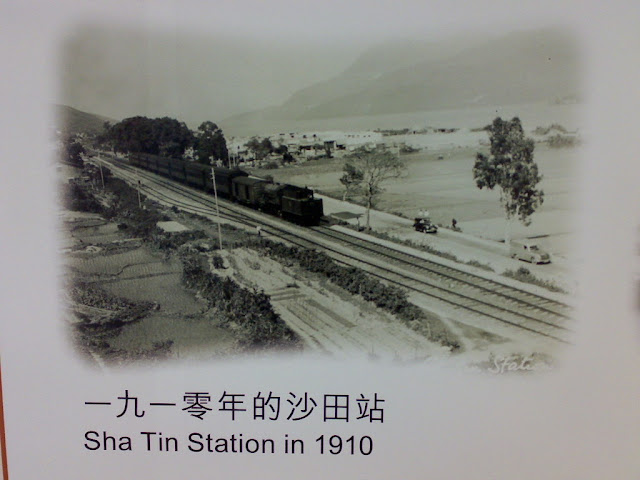
Sha Tin train station. Nowadays at Sha Tin train station is a multi-story mall, an Ikea, and several high-rises This is the inside of a train, this picture featuring a hawker. This is still a common sight in India. Old Kowloon. An old train schedule, written in Chinese. Victoria harbor a couple decades ago.
It wasn't quite independence, it was a handover, from British rule to Chinese rule. But my impression was that a lot of Hong Kongers liked British rule, some of them so reluctant to be under China's political administration as to migrate to other countries. But after the economic downturn, things have looked up in the city, and I sense that for Hong Kongers, as long as there's a means of living, and nobody much bothers your way of life, then they couldn't much care for who was in charge, nor whether they've got a vote or not. Fireworks and theme songs turned out to be what they are - performances, just for show.
This is the view I got from TST East, too far away to hear them play Andy Lau's “中國人” Sorry for the poor quality! But at least I went, whereas most HK'ers don't bother, saying "it's too crowded...what's so great about it anyway?" People made a big deal that they made the shape of some fireworks into the characters for Chinese people "中國人" ...which you can see from 3:17-3:27. But I get the biggest kick from the non-stop steady "WAA!" throughout the whole video.
My friends' and my rendition of the 10th anniversary song, which they play over and over again in the MTR stations, "香港此總有你" - translated "Hong Kong has you in the end." The Karaoke video shows various scenes like horse-racing and the HK-stock exchange, while I sang the corny Mandarin one-line response "because you are here!"
After having a curry dinner in Mong Kok with Irene, Kar Wai, and Agnus, I hurried over to Prince Edward to the Sports Facility no.2, walked late into the squash court turned-into G. Capoeira Brazil Hong Kong beginner lesson floor. After a few jengas and other basic moves, Squirrel and Mona Lisa (these are their Capo nicknames) gave me gifts of black sesame-themed snacks. "I was the one that went travelling, I thought I was supposed to give the gifts!" I said.
"We remembered how much you like black sesame!" they said to me, referring to an inside joke from the dinner of my last night in HK a couple months ago. "Thanks!" I said to them, "I got you gifts too, from Japan, but I forgot to bring them out today!" After the lesson I went with the two of them along with the Mask (another Capo name inspired by the fact that Mestre thought he looked like Jim Carrey from The Mask) for singing Karaoke. We sang until 2 in the morning, me trying to pull out every single Chinese song I could sing, since the English songs I sang didn't seem to inspire any sense of fun from them. The Mask said he'd call in sick the next morning, while Squirrel sent me a text in all capital letters when I was at the airport, telling me she was really happy so she wasn't tired and work was OK. Before I went to the airport, I had lunch with Mona Lisa so that I could give her the gift I'd intended for her and Squirrel. She was the only one out of them all who wasn't working, since she'd just graduated from City U. Of course, I asked the standard question of what she wanted to do next.
I was struck by the importance of "Yeuhng Ga" in her job-search...which literally translates to "raise/support family." It's the standard custom in Hong Kong to financially support your parents as soon as you graduate and get a job. This isn't a secondary consideration, it's a guiding and principle factor. New grads choose their jobs and direction in life based on the necessity to pay up to their parents; interest and "calling" don't seem to factor as much into it as it does for new grads in the US. Yet, the HKers I've talked to seem to accept this responsibility of "yeuhng ga" without reluctance...without taking it up as if it were some burdensome chore their parents pushed them to do. Even if the parents have enough money, my friends give them money just out of symbollic gratitude.
Mona Lisa wants to be a school teacher. I, on the other hand, have no idea what I want to be...which is an attitude that seems to plague many American new grads. After our lunch, I flew to Bangkok, where I'd indulge in nostalgic reveries and nighttime licentiousness for the next 4 days and 4 nights.
I spent both my nights in Hong Kong in the rural hills and sparsely populated area called Yuen Long. Most tourists who visit Hong Kong see the uber modern and newly built dimension of the city. Even the Po Lin monastery big buddha, which didn't exist over a decade ago, can now be reached by aerial cable cars from Tung Chung, one can now see at the transfer subway station for the newly opened Disneyland there is a special line where the subway cars have mickey-mouse shaped windows, and the Victoria peak has been topped with a brand-name shopping complex.
But as I have a penchant for old things and history, I like to look underneath that all and see what once was. For example, Kowloon Walled City. "Originally established in the eighteenth century as a far-flung outpost of the Chinese empire..." it was never really a city. When the British took Hong Kong island and Kowloon, China kept the walled area to keep a military presence there to guard against England. But when the New Territories were ceded over, Kowloon Walled City became a political no-mans land, neither China nor England owning it. Squatters took up residence there, but there was no rule of law, no police, no garbage collectors, no sewage. Electricity was illegaly and slyly tapped from the main grid. Some of this information I garnered from a book I just finished called Gweilo, memoirs of a British boy's childhood in Hong Kong. I found myself in Mong Kok two days ago, drinking Pacific Coffee coffee, reading his book, and then walking over to his urban "playground", especially touched when I went to the spot of my favorite anecdote from his book. There was a "Plink Plonk man" who played the Xylephone on the streets and his pet monkey dressed in traditional Chinese mandarin uniform danced mechanically to his music.
All went well until one day when, halfway through 'Marching through Georgia', the monkey finally managed to bite through its leash. I was on the opposite side of the road and watched the whole drama unfold. In a flash, the monkey was up the nearest tree. The music stopped abruptly and the plink-plonk man stood up to survey the situation. The monkey was out of reach, the tree too stout to bend and the remnant of the leash too short to be grabbed. At first, the musician tried to sweet-talk the monkey down, holding up a piece of a bun. The monkey just peered down through the branches. Not to be hoodwinked by this, it then slowly, strip-tease fashion, divested itself of its ludicrous costume, letting each piece drift to the ground where the musician collected them up, folding them as he might those of a child. His attention taken by this task, the plink-plonk man's eye was briefly off the monkey which, holding on to its little cock, gave it a few masturbatory tugs before proceeding to urinate upon its erstwhile master. It was a moment or two before the musician realized what was happening. He unwisely looked up to be hit in the face by the full stream. This not surprisingly drove him into an irate frenzy, cursing the monkey at the top of his voice, throwing the clothing at it and then pelting the monkey with unripe olives, some of which it caught and returned with considerable accuracy, the hard fruit bouncing off the musician's head. Tiring of this game, the monkey headed off down the street, swinging Tarzan-like from tree to tree, always keeping just out of reach of the musician who ran below, jumping up to attempt to grab the dangling leash. It was pure pantomime and, by now, had gathered a crowd far greater than any the plink-plonk man could ever have hoped to collect through is music. He ran along behind the escaping monkey, his face wet with urine, his fists clenched, pleading, cussing, cajoling and threatening the creature by turns. His swelling audience, meanwhile, hooted with laughter, shouted spurious advice and encouragement to the escapee. At the junction of Emma Avenue and Soares Avenue, a network of electricity wires spanned out from a junction box. The monkey, blithely swinging through the foliage, was unaware of the danger. The plink-plonk man saw it and tried in desperation to turn the monkey back. Enjoying its liberty, it ignored him. There was a violent blue flash accompanied by an equally brief high-pitched squeak. The lights in the shops flickered. A few bulbs exploded. The monkey was instatnly immolated. All that was left was a charred corpse stretched between two wires, adrift of smoke and the acrid smell of burnt hair. The plink-plonk man sat on the curb, his feet in the gutter, and broke into tears. The crowd, now subdued, dispersed. I never saw him again.
I went to the junction of Emma Avenue and Soeares Avenue. There was no more network of electiricity wires spanning out from a junction box.
Landing at Hong Kong International Airport, I looked in my passport to see that it was only 2 months ago, exactly, that I left. Two of my cousins, Jing and Cheung, came to pick the three of us up - my mother, my father, and I. As we walked out into the sauna-humid Hong Kong air, I noted the lack of any sensationalist feelings in myself over being here, which means this place just feels like another city that I go to, like Boston, New York, or Albany...and it feels just as close, in some ways closer to me than it is closer to my mother, whom has never been to Temple Street - a narrow street surrounded by an eclectic mix of daaih paaih dohng outdoor eateries, stalls of cheap plastic toys for sale, palm-readers who mystify their appearance to increase business, and sex stalls that include dildos, whips, and other such toys. Our hotel is just blocks away from here.
Red and green auras of light hovered in the cloudy night sky as we drove there, perhaps remnants of fireworks and lazer shows commemorating the handover. Two couples, friends of my parents, surprised us at our hotel and brought us down to eat at a restaurant. As they jabbered away, Jing and Cheung sat in awkward silence, evincing to me one of the pitfalls of Hong Kong culture - strangers don't know how to talk to one another. The most that was spoken between them was "M hou haak hei, sihk la!" Don't be formal/courteous, eat up! So my parents and their four friends caught up over life, as I watched the dancing and singing on the TV overhead, an uninterrupted commemoration program, as we all chowed down various parts of pig, the fat, the meat, and the intestines, served over rice.
 Lydia Shum, also known as 肥肥 (literal translation: fat fat. Of course this sounds horrible in English, but in Chinese it's taken as a term of endearment), is also known as 開心果: Happy Fruit, because she was known for her radiant and contagious smile. She was an actor, a singer, and a game show host (Hong Kong celebrities tend to do absolutely everything), but of course, she was much more than that to Hong Kong people. A woman interviewed on the street on TV put it poetically: "If we were never graced by her legacy, the sun wouldn't be shining as brightly as it does today in Hong Kong." Even I grew up with her presence on my family room TV in Massachusetts, even though I rarely watched the Chinese programming. She passed away about 2 weeks ago of liver cancer, an all too common disease in China (and which nearly claimed the life of my mother if not for the successful surgery).